
John Katona, D-Day, and an Unsolved War Crime
Table of contents
Erzsébet’s Son
This is a difficult story to tell because I know the impact it had on Erzsébet’s life.
This series of articles (Parts I-V) is about Erzsébet Molnár Katona: her birth in Zarkahaza, Hungary, in 1893; her immigration to America in 1913; her marriage to Andy Katona in Cleveland in 1919; and the household she built at 8123 Holton Avenue. Three sons. Twenty years in the same neighborhood. Census records that show stability, consistency, and an ordinary immigrant life becoming an ordinary American one.
Her second son was John. Born June 21, 1921. He appears in the 1930 census at age eight and in the 1940 census at age eighteen. On his mother’s naturalization petition, filed in 1940, a clerk added a handwritten note: “Frank and John are now in the U.S. Army.”
John married a woman named Mary. They lived at 8103 Holton Avenue, twenty house numbers from his parents’. He was a paratrooper with Company C, 507th Parachute Infantry Regiment, 82nd Airborne Division.
On June 6, 1944, he was twenty-three years old.
He did not survive D-Day.
The Massacre at Hémevez
The paper trail is unusually complete for a wartime death. Not because it is obscure. A historian named Martin K.A. Morgan wrote the definitive account of what happened near the village of Hémevez on D-Day, and motion picture footage of the aftermath sat in the National Archives for over fifty years before anyone connected it to this story. [1]
Shortly before 11 pm on June 5, 1944, a C-47 aircraft took off from Fullbeck airfield in England carrying fifteen paratroopers from Headquarters Company, 1st Battalion, 507th Parachute Infantry Regiment. Their mission was to drop over Drop Zone T, three miles northeast of Ste.-Mère-Église. [2]
They never made it to the drop zone. Dense fog caused the aircraft to drift off course. At 2:44 am on June 6, the paratroopers jumped into the darkness and landed four miles northwest of their target, in a field outside the village of Hémevez.
Fourteen men made the jump. One man’s reserve parachute had opened inside the aircraft; he stayed behind. Two men were injured on landing. Lieutenant Robert Shutt gathered the group and moved them into a small wooded area for cover.
At dawn, a German patrol found them.
What happened next became the subject of a Supreme Headquarters Allied Expeditionary Force Court of Inquiry. The court’s findings, dated March 7, 1945, state that seven American soldiers were killed near Hémevez on June 6, 1944 [3]. Six of them were prisoners of war at the time of death. The court found that four or possibly five of the prisoners were taken to a German headquarters at the Château d’Hémevez, searched, and interrogated. Immediately after interrogation, they were marched back to the woods where they had been captured and shot.
The court found that these killings “was in violation of the well-recognized laws and usages of war and the terms of the Geneva Conventions of 1929 and was murder.” [4]
One soldier, Private Robert Watson, had injured his ankle during the jump. He could not walk without assistance. The medical examination after exhumation found that he had been beaten to death with a rifle butt. [5]
Pierre Renault, a French civilian, was bicycling to work that morning. He saw four American prisoners being marched by four German guards through a cattle gate and into the field leading to the woods. He continued to his job at a nearby farm and began chopping wood. At about 8:00 am, he heard twelve to fifteen gunshots. The shooting lasted two or three minutes. [6]
That afternoon, a villager named Leon Lequartier went into the woods to collect kindling and found the bodies. [7]
The Eighth Man
The court’s findings do not end with seven.
Finding states:
“That an eighth American soldier met his death in the neighborhood of the village of HEMEVEZ on the 6th or 7th of June 1944.” [8]
That soldier is identified as “Pvt. JOHN KATONA, 35319504, whose unit is not known to the Court.” [9]
And then the finding adds a statement that stopped me when I first read it: “That there is no evidence to show when, where, or in what manner the said Pvt. JOHN KATONA was killed.” [10]
John was not part of the stick that jumped from that C-47. He was from Company C, not Headquarters Company. His body was not found in the woods with the other seven. The court’s summary of evidence states that on June 7, 1944, the mayor’s assistant, Emile Lainé, was informed that another dead American paratrooper had been found. [11]
“This body was found at the foot of a tree in the environs of the Chateau” and “was … under guard of two German soldiers.”
The medical examination conducted during exhumation on June 22, 1944, found that John Katona had an abdominal gunshot wound.
The court noted:

“His wound is consistent with its having been received in combat.” [12]
Because the mass grave for the seven had already been sealed, John was buried alone in a separate grave nearby [13]
The Investigation
Hémevez remained under German occupation for eleven days after D-Day. On June 17, 1944, American forces reached the village. Emile Lainé turned over the dog tags and personal effects he had collected from the eight buried Americans. He told them the paratroopers had been captured, disarmed, and executed.
Five days later, on June 22, a team from the U.S. First Army’s Inspector General Division arrived at Hémevez. Colonel Rosser L. Hunter led the investigation. The team included personnel from VII Corps headquarters, the 603rd Quartermaster Graves Registration Company, a translator, and two photographers from the 165th Signal Photographic Company: one shooting stills and the other shooting motion-picture footage.
The team went first to the woods. They conducted a thorough search and identified the exact spot where each of the seven paratroopers had fallen. They marked each location with pages from a pocket notebook: A, B, C, D, E, F, and G. Using soldiers from the First Army as stand-ins, they staged a reenactment of what Pierre Renault had witnessed that morning: four German guards marching four American prisoners through the cattle gate and across the field to the woods. [14]
Then they moved to the church cemetery to exhume the bodies.
They started with John Katona’s grave. His body was removed, placed on a stretcher, and examined by Captain Theodore F. Wright of the Army Medical Corps. After documenting his wounds, they opened the mass grave containing the seven men from Headquarters Company.
The French villagers had done what they could. They had no time to build caskets, so they laid the bodies at the bottom of the hole, inserted three crossbeams, and covered them with wooden planks. One by one, the bodies were lifted out and examined. Captain Wright recorded every wound.
The eight bodies were loaded onto a truck and trailer belonging to the 603rd Quartermaster Graves Registration Company and driven ten miles to Ste-Mère-Église, where they were buried in the first temporary U.S. military cemetery.
Sergeant Maloney’s footage eventually made its way back to the United States and into the National Archives. For over five decades, it sat there without context. The name “Hémevez” was not listed in the finding aids or on the film reel itself. The footage existed, but no one knew what it showed.
The Court of Inquiry
On November 1, 1944, a formal court of inquiry was established under the authority of General Eisenhower’s Supreme Headquarters. On December 14, the court convened at the mayor’s office in Hémevez. Testimony was heard from the three surviving members of the dawn patrol that had been sent to find help.
The opening of the Battle of the Bulge on December 16 interrupted proceedings. The court reconvened on January 13, 1945. Pierre Renault testified. Emile Lainé testified. The court interviewed Landry again on January 16.
The final report was published on March 7, 1945. It found that the killings violated the Geneva Conventions of 1929 and constituted murder. It identified a prima facie case against Major Wilhelm Felix, the German officer in charge of the château’s supply depot. But Felix denied ordering the executions. He blamed it on non-Germans from another unit. No one else was ever identified. [15]
No one was ever placed on trial. The case was closed.
Returned Home
On August 4, 1944, the War Department issued a Report of Death for Pvt. John Katona. The form lists his beneficiaries: Mrs. Mary A. Katona, wife, at 8103 Holton Avenue, Cleveland, Ohio. Mrs. Elizabeth Katona, mother, and Mr. Andrew Katona, father, at 8123 Holton Avenue. [16]
John’s body remained at Ste-Mère-Église until 1948, when the temporary cemeteries were closed. All eight of the Hémevez soldiers were exhumed a second time and moved to the U.S. Military Cemetery on the bluff above Omaha Beach near Colleville-sur-Mer.
Years after the war, the government offered families of the war dead a choice: leave their loved ones buried in overseas cemeteries, or have them returned to the United States at government expense.
A Disinterment Directive dated April 15, 1948, records the movement of John’s remains. The document notes his burial location: St. Mère Eglise No. 1 Cemetery, Carentan, France. Plot P, Row 6, Grave 119. [17]
The Katonas chose to bring John home.
On November 6, 1948, Andrew Katona signed a government form requesting reimbursement for interment expenses. He paid $83.55 to bury his son at Calvary Cemetery in Cleveland. [18]
The form required a signature and a relationship to the deceased. Andrew Katona wrote: “Father”.
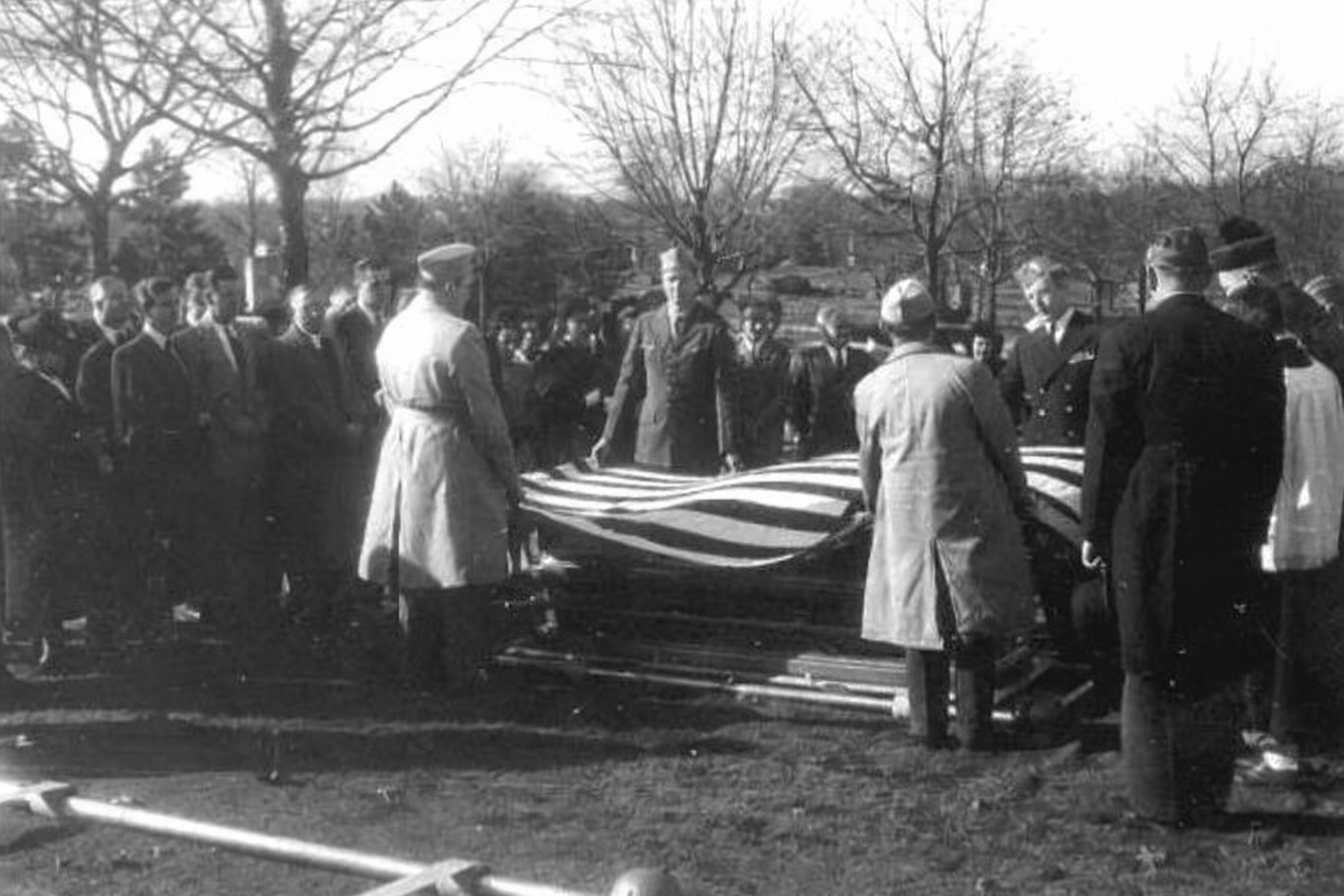
Pvt. John Katona burial, Calvary Cemetery Cleveland Ohio, December 1948.
What Remains Unknown
The memorial at Hémevez lists seven names. John Katona’s name is not among them.
The sign on the cattle gate where the prisoners were marched to their deaths reads: “Passant, souviens-toi…” (Passerby, remember…). It commemorates seven American paratroopers of the 507th Infantry Regiment who were taken prisoner and executed in that place. “Ces 7 martyrs sont morts pour la France. N’oublions jamais.” (These seven martyrs died for France. Never forget.)
John was not one of the seven. He was not part of their stick. He was not captured with them. He was not executed with them. His wound was consistent with combat, not execution.
But he died at Hémevez, and his body was found near the château. He was buried by the same villagers who buried the others, in the same cemetery, on the same days.
Martin K.A. Morgan, who wrote the definitive account of the massacre, noted that “John Katona of C Company, 507th is not listed, but his presence at Hémevez is a recent revelation, and something might yet be done to acknowledge that his life ended there at about the same time as the others.”[16]
I do not know how John came to be at the end of the château’s carriage road. I do not know if he jumped with a different stick and landed nearby. I do not know if he was wounded elsewhere and made his way toward the village. I do not know why two German soldiers were guarding his body when it was found.
The court did not know either. That is the point.
Some records tell you what happened. Some records tell you what cannot be proven. The Hémevez file does both.
What I Do Know
John Katona was Erzsébet’s son. He was born in Cleveland in 1921. He married a woman named Mary. He was a paratrooper. He went to France in the summer of 1944 to help liberate it.
He died on D-Day, or the day after. He was twenty-three years old.
French villagers buried him with care. American investigators exhumed him and documented their findings. His government brought him home.
He is buried at Calvary Cemetery in Cleveland, Ohio.
This is what the paper trail actually leads to, if you follow it far enough. Not every story ends with a family reunion or a discovered photograph. Some stories end with a court of inquiry that cannot determine how a man died.
This was and still is a difficult story to share because I know the impact it had on Erzsébet’s life.
What Comes Next
Erzsébet outlived her son by five years.
In 1949, a Cleveland newspaper ran a headline: “Woman Dies in Jail Probate Ward Despite Plea to Hospital.”
The woman was Erzsébet.
Next week: Part VII, “The Line on the Death Certificate I Wasn’t Expecting.”
Resources
Footnotes
[1] Martin K.A. Morgan, “Massacre at Hémevez,” Warfare History Network.
[2] Morgan, “Massacre at Hémevez.”
[3] Morgan, “Massacre at Hémevez.”
[4] Supreme Headquarters Allied Expeditionary Force, Court of Inquiry re Shooting of Allied Prisoners of War by the German Armed Forces at Hemevez, Manche, Normandy, France, 6 June 1944 (Report dated 7 March 1945), Part II, Section I, Finding 1.
[4] SHAEF Court of Inquiry, Finding 4.
[5] Morgan, “Massacre at Hémevez.” Describing Pierre Renault’s testimony.
[6] SHAEF Court of Inquiry, Finding 5(a).
[7] SHAEF Court of Inquiry, Finding 5(b).
[8] SHAEF Court of Inquiry, Finding 5(c).
[9] SHAEF Court of Inquiry, Part II, Section II, Summary of Evidence, para. 28.
[10] SHAEF Court of Inquiry, Summary of Evidence, para. 28.
[11] Morgan, “Massacre at Hémevez.”
[12] Morgan, “Massacre at Hémevez.” Describing the June 22, 1944, investigation.
[13] Morgan, “Massacre at Hémevez.”
[14] SHAEF Court of Inquiry, Part I, paras. 3–6.
[15] SHAEF Court of Inquiry, Finding 4 and Finding 7(d).
[16] War Department, Adjutant General’s Office, Report of Death, Katona, John (35319504), 4 August 1944.
[17] Disinterment Directive No. 3584 00977, 15 April 1948.
[18] Request for Reimbursement of Interment or Transportation Expenses, World War II Deceased, filed by Andrew Katona, 6 November 1948.