

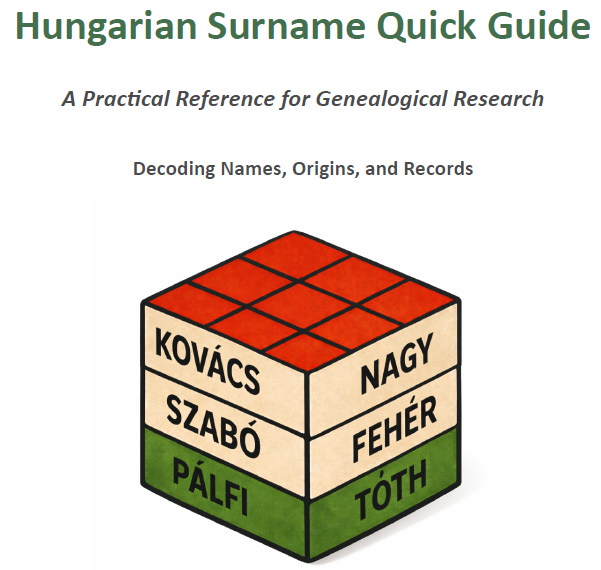


Hungarian Surname Quick Guide
$15.00
Stop guessing whether Kovács, Kováts, and Kovach are the same family: this guide explains how Hungarian surnames shift across records and how to search them effectively.
Description
Hungarian Surname Quick Guide
Understand how Hungarian surnames behave in records.
You found a Kovács in 1847. Then a Kováts in 1872. Then a Kovach on a ship manifest. Same family? Different families? The record doesn’t tell you, and neither does the search engine.
Hungarian surnames don’t follow the patterns you learned from English or German research. Names appear surname-first. Married women vanish behind their husband’s full name. Spellings shift depending on who held the pen and what language they wrote in. And the Magyarization campaigns? Those changed surnames entirely, sometimes leaving no obvious link between the old name and the new one.
This guide explains what’s actually happening in the records, so you can search smarter and avoid the traps that catch most researchers.
What’s Inside (18 pages, print-friendly PDF):
- What Makes Hungarian Names Different: Surname-first order, the -né married-name system that obscures women’s identities, and why accented and unaccented spellings are almost always the same family
- What Surnames Cannot Prove: A realistic framework before you draw conclusions about ethnicity, nobility, or village of origin
- The Four Surname Categories: Occupational, nickname, patronymic, and ethnonymic/toponymic, with examples, frequency data, and research implications for each
- Regional Patterns: How surname distribution varies across Hungary and Transylvania, and why it matters for your search
- Spelling Variants and Record Languages: Common transformations, suffix meanings, and a worked example showing how Kovács appears across Hungarian, Latin, German, Slovak, and American records
- Magyarization: Time periods, common change patterns, search indicators, and where to find name-change databases
- Quick Reference: Common surname myths debunked, online starting points, and a compact Hungarian-Latin record vocabulary
- Glossary: Hungarian-English genealogical terms
- Sources: Further reading from Hungarian academic scholarship
Who This Is For:
- Researchers who keep finding spelling variants and aren’t sure which ones to chase
- Anyone confused by how women’s names appear (and disappear) in Hungarian records
- Genealogists who want to understand the system, not just memorize translations
- Researchers preparing for deeper work with Hungarian church or civil records
Who This Is Not For:
- Researchers looking for a surname dictionary or lookup tool (this explains patterns, not individual name meanings)
- Anyone wanting step-by-step research worksheets (see the Hungarian Surname Research Toolkit for that)
What You’ll Learn:
- Why searching without accents should be your default strategy
- How to spot whether a spelling variant is the same surname or a different one
- What the -né suffix actually means and where to find a woman’s birth name
- Which surname types suggest (but don’t prove) certain ancestral backgrounds
- How to recognize signs that a surname may have been adopted during Magyarization
- Where to search for official name-change records
Format: PDF (18 pages, print-friendly) Delivery: Instant digital download
Reviews
There are no reviews yet.